Domestic and Family Violence Typologies - Differences in Risk of Harm
So excited to announce that my Psychology Honours research project has officially been published with the Journal of Interpersonal Violence!
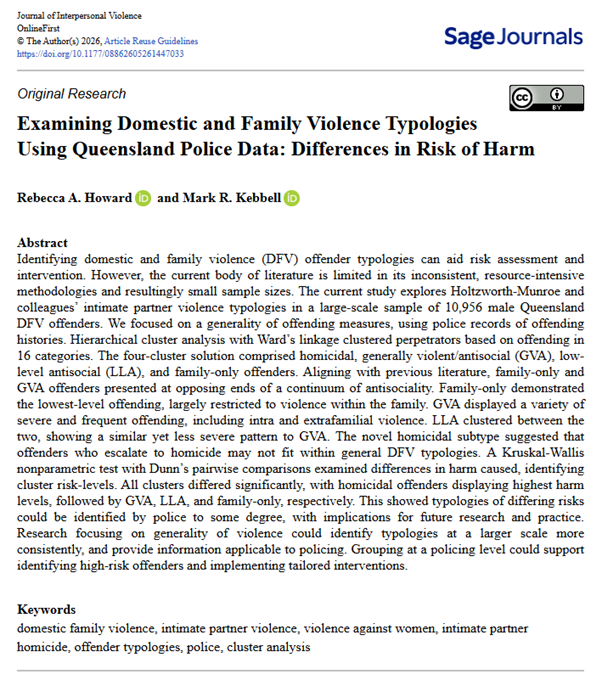
We looked at offender typologies using Queensland Police Service data on nearly 11,000 DFV offenders, and found four distinct types: Family-only, low-level antisocial, generally violent/antisocial, and homicidal offenders. Using harm index scores (adapted from the Western Australia Crime Harm Index [WACHI]) we found these groups differed significantly from one another in the harms they caused.
Aligning with previous literature, family-only offenders caused least harm and committed fewest crimes, largely restricted to within the domestic sphere, while generally violent/antisocial offenders committed a wider range of crimes more frequently, causing higher harm. Low-level antisocial offenders committed a similarly wide array of crimes but to a lesser severity, sitting between family-only and generally violent/antisocial offenders in harm level.
Homicidal offenders were characterised by committing at least one homicide related offence and causing highest harm, indicating offenders who escalate violences to homicide do not predictably fall within previously identified groupings of IPV offenders.
This research demonstrates that typologies of differing harm levels could be identified by police to some degree, with implications for future research and practice.
These findings are what drove me to pursue my current PhD project, which aims to identify risk factors predictive of severe and lethal DFV. As homicidal offenders do not fall neatly into the three commonly seen ‘types’ of DFV offenders (family-only, low-level antisocial, generally violent/antisocial), I want to see what we do know about them, and how we can use the information already gathered by police to better predict these crimes.
Thank you to my amazing family for sticking with me, and accepting that now the family dinners will include discussions of homicide if you ask about my work. And thank you to my always wonderful supervisor Professor Mark Kebbell, without you I would never have come this far!
Read the academic paper here:
Howard, R. A., & Kebbell, M. R. (2026). Examining domestic and family violence typologies using Queensland Police data: Differences in risk of harm. Journal of Interpersonal Violence. Advance online publication. https://doi.org/10.1177/08862605261447033
Rebecca Howard