ISIS Brides - The Roles Women Play in Violent Extremism
The return to Australia of the “ISIS Brides” has renewed debate about the role women play in violent extremism. A common assumption in public commentary is that, because they are women, they pose low risk. The evidence suggests otherwise.
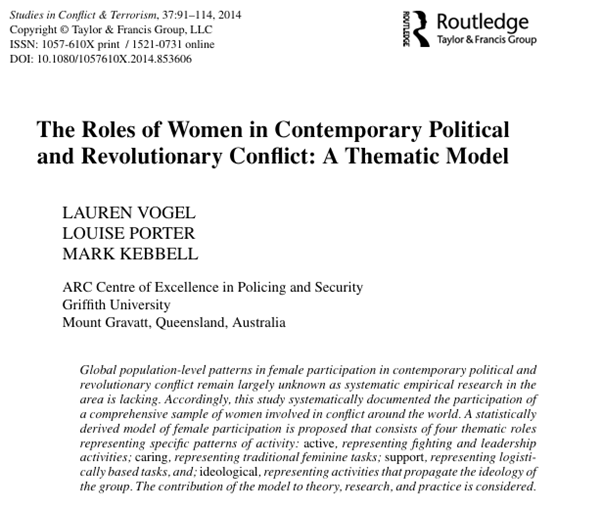
Women have contributed to extremist and revolutionary movements in significant and varied ways, and this should not be minimised. In our research, led by Dr Lauren Vogel, we examined 482 women who played notable roles in political and revolutionary conflict, including Islamist movements, to better understand how women contribute to the perpetration and support of violence.
We identified four broad thematic roles:
Active — fighting, operational, and leadership activities
Caring — traditional domestic and caregiving tasks
Support — logistics, facilitation, and organisational support
Ideological — propagating and reinforcing the group’s ideology
These categories provide a more nuanced framework for understanding risk, engagement, and management strategies relating to women involved in extremism.
The discussion should move beyond simplistic assumptions about gender and focus instead on the diversity of roles women can occupy within extremist movements.
News article: https://www.abc.net.au/news/2026-05-08/woman-charged-terror-related-offences-sydney-isis-syria/106656426
Our academic paper: Vogel, L., Porter, L., & Kebbell, M. (2014). The Roles of Women in Contemporary Political and Revolutionary Conflict: A Thematic Model. Studies in Conflict & Terrorism, 37(1), 91–114. https://doi.org/10.1080/1057610X.2014.853606
Prof Mark Kebbell